Showing posts with label architecture. Show all posts

Sunday, 8 July 2012

sunday walking


Finally did the walk along the Moskva River embankment, something I have wanted to do all my time in Moscow. Started from the Kotelnicheska Embankment building - one of Stalins 'seven sisters' skyscraper buildings (thanks to staying there with the endlessly generous N + I) - on a lovely sunny Sunday afternoon. Then strolled past the Kremlin to Ostozhenka ( a district nicknamed the Golden Mile and home to both wealthy mansions and some good contemporary architecture).

The only problem, besides the incessant drone of traffic, is actually finding a way to get onto the riverside path itself. There seems to be only one underpass on the whole stretch. And the only alternative is a weird zebra crossing arrangement where you go half-way across one crossing, and then have to wait in the middle, in order to go via another crossing set at right angles to this one, whilst the cars zoom past curving either to your left or your right. Me and a young Russian guy both hovered at this mid-way point, unsure whether we wanted to risk our lives. And - as at other times when I have tried to cross a Moscow road - he followed the safety-in-numbers attitude, by grabbing my arm and hauling me out into the traffic...before the lights had changed. I tried to hang back, gesticulating wildly at the lights, but he took an even firmer grip, yelling 'Together, or I will die', and across we went with cars careering around us and hooting madly. 

And then, when we got to the river itself, he wanted, of course, to walk with me and practice his english.

Saturday, 7 July 2012

new garage


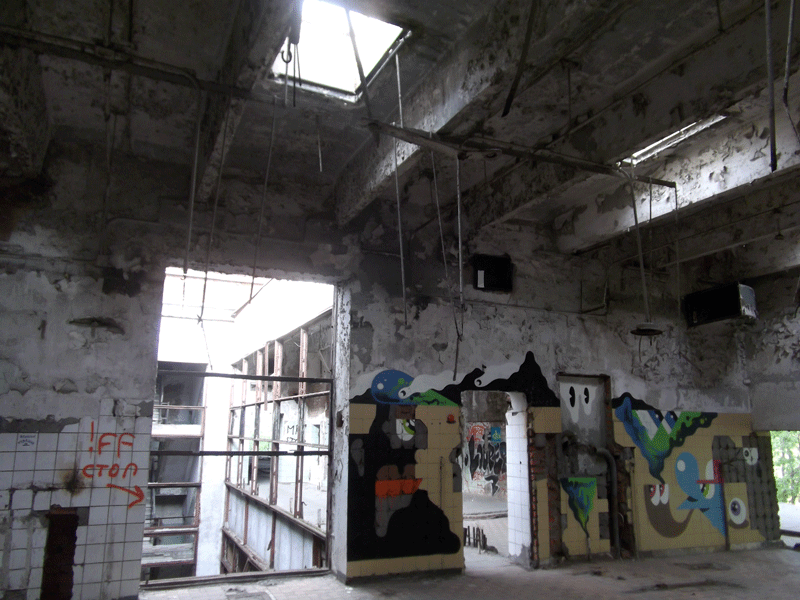
As also mentioned before, one of the reasons for the Gorky Park make-over is investment by Roman Abramovich. This includes a planned conversion of a derelict 1960s modernist restaurant (for his partner Dasha Zhukova) into a new Garage Centre for Contemporary Culture, now that the old one that she created has been closed down. Architects Rem Koolhaas  and local firm Form Bureau have been given the job - with Koolhaas saying at the press conference, “Neglect is quite picturesque and offers insights into the beauty of decay,” pointing out that he planned to keep the original tiles, decoration and other “traces of Russia's recent history.” Amazingly we got to look around the building site, I think just because the security guard was bored. The basic two storey concrete shell and main staircases are tatty but still intact, and it already feels like a perfect art gallery. 


To see the Koolhaas/OMA proposals, click here.
To see the planned temporary pavilion by Japanese architect Shigeru Ban, click here. 

10-of-the-best 5: Bar Strelka


Even in the brief time I have been away, the Moscow art and design scene seems to have blossomed (it being the summer obviously helps). Finally made it to Bar Strelka, for an evening drink on the high-level outside terrace overlooking the river; definitely one of the coolest places to be right now. In fact the whole Red October factory island is buzzing. Read a brilliant piece by the author Gary Shteyngart ("Born in Leningrad, U.S.S.R., in 1972, I have been coming back almost every year since my late twenties to poke fun at my birthplace"). He calls Strelka the centre of 'the Snob universe', Russia's very own glossy for the cultural elite; but also hopes (hopelessly) that places like this can be part of making the country more 'normal' - for "If Russia can become a normal country, then maybe my past can be normalized, too" .


For more cool spots outdoor eating and drink spots, read this from moscow-in-your-pocket.
For more about Bar Strelka, and the Strelka Insitute, see this video.  

'at least one surreal thing a day..'


Made it back to Moscow at last, for a week. Still so much in love with this place. If anything, even better going back as a tourist - knowing where I am but not being exhausted by the normal difficulties, just enjoying the many weirdnesses relative to bland old London. Which included a 4 hour traffic jam from the airport to the hotel, thus arriving at midnight, only to then remember that the hotel named on the visa voucher was just there to make it easy to get a tourist visa*, not because I was ever intended to stay. So no booking. Had to borrow the cash off of V to get a room for the night (no credit cards taken).

But good room, and inexpensive for Moscow. Plus, right next to Izmailovo Park, which I never got to before, partly out of a lack of enthusiasm for its over-hyped and (mainly) tacky souvenir market. So never quite sussed that it is a small-scale Russian-style over-the-top Disney-World. Ridculous and brilliant.**


* For those not in the know, if you travel to Moscow planning to stay at a friend's place, then you have to go through a nightmare arrangement involving personal invitations and separate registration processes. So, instead, everyone uses travel agents that just randomly name a hotel, just for the paperwork.
** Go here to see (slightly dated but nice) photographs of the Izmailovo market stalls. 

Saturday, 28 January 2012

sad but true


Went to visit the Shukhov Radio Tower today, which was top of my list of things to do. Why you may ask? Because it was the most amazing bit of 1920s engineering, a lightweight steel lattice grid, completely radical at the time: and because Alexander Rodchenko took some fab photos of it.  It is also under threat of demolition and I am an architectural junkie. I took a walk, based on this one from the Moscow News, although in reverse, that is, coming out of Shabolovskaya metro station first (the tower is directly opposite) and then going to Leninsky Prospect - not the prettiest bit of town, but quite representative. 


Also made me realise that I may be in Moscow, but I am a typical Londoner - I have my patch and don't go much beyond it. So in two and half years here have only infrequently been south of the river or over to the Arbat and the west-side. OMG, so much still to see.

Monday, 21 November 2011

protesting (1)


Got momentarily excited by this poster, suggesting that some political protest was at last happening in Moscow, until I realised that it was just a design student project. In fact, some of the liveliest campaigning groups in Moscow seem to be around architectural heritage and its destruction (no Occupy movement here yet).

The group Archnadzor  has brought together some of the different preservationist groups and do a lot of campaigning including some direct action - still a risky business in Russia. You can see some old photos at Moskva Koterey Net (The Moscow that is No More) of what has already been demolished to make way for the post-Soviet/Capitalist Realist boom; and read more at MAPS (MoscowArchitectural Preservation Society) - the only site with an English language version.

Sunday, 23 October 2011

more hanging

There seems to be a lot of building work going on, both new construction and renovation. It is almost too easy to add to my collection of people hanging off buildings.

Saturday, 22 October 2011

the place of art


The Perm contemporary art gallery (now re-badged PERMM) is currently housed in an old ferry terminal, down by the river Yama. It had been abandoned, and still looks both small and frayed at the edges; not quite of the calibre of its references (Bilbao, MOMA, Tate Modern, CaixaForum, etc., etc.) But at the same time, the ambition is impressive. I met a young curator who is involved in the task of building a permanent russian contemporary art collection. Perm may not want it, but still nothing of that scale is happening in either St. Petersburg or Moscow as far as I know. And her enthusaiasm was a lovely thing to see.


Sunday, 16 October 2011

details


The older wooden houses in the centre are amazing. Easy to see these as picturesque ruins and to photograph their beautiful, lop-sided, hand-crafted details without thinking much about the occupants.

I was also shown rows and rows of wooden barracks on the outskirts of the city, still surviving from the 1920s, built in that optimistic moment in the belief that a the new type of worker would be formed who would not need a private kitchen or much domestic space. Again, still occupied and almost completely collapsed. 

Sunday, 9 October 2011

idyllic?


This idyllic scene is literally 3 minutes walk from where I live; an unexpectedly Parisian-looking section of the Yauza river, a shallow tributary to the Moskva. There is a beautiful pink and white neo-classical set of buildings for the lock machinery and (presumably) the lock-keeper, given that the middle island has a small but exquisitely kept garden and house.  And I hardly ever go there, because both sides of the river are major traffic routes. Most times of the day it is completely impossible to cross. And I mean impossible; the flow of very fast traffic never stops. At weekends it is fractionally quieter, so yesterday I took my life in my hands, and ran.

And on the other side of the road there is this short stretch of path by the water which is separated from the cars by a small park. Lovely.

Friday, 7 October 2011

hanging about (more)


...and the other, other obsession - people hanging off buildings from basically just two pieces of string...

Tuesday, 13 September 2011

the look of fresh pine

The park is currently in the beginnings of a make-over with the derelict rides and attractions being stripped out and - from the look of it - 'hipsters' being invited in. Work is being funded by the City government and Roman Abramovich, with one of his lieutenants Sergey Kapkov put in charge of the renovations. So there is a new outdoor cinema (where I watched some of the park's security guards - in full uniform - calmly try and jemmy open the storage shed, which could be seen to contain much useful stuff); a beach restaurant (with an actual beach); wi-fi everywhere; new stylish seating areas and many, many new espresso bars. The overall look is planks/boxes of stripped pine, so it is no surprise that Strelka Institute have been involved - they brought this look to Moscow.

If you want to be reminded of the summer, then see Gorky Park's new 'beach' as well as other kind-of-beaches around Moscow via this RT YouTube clip 


Monday, 12 September 2011

wash out


Spent much of sunday getting very wet in Gorky Park, at Design Act - billed as a design festival and exhibition, but washed out almost completely. Making the market stalls and furniture out of cardboard was probably a bad idea (and presenting a lecture where power cables + damp meant my laptop gave off electric shocks whenever you touched it was interesting to say the least) .


Monday, 5 September 2011

ugly, ugly, ugly


V also deliberately took me on different routes to and from his dacha. On the way there we saw endless new high-rise apartment building (both on Moscow's outskirts and around the nearby 'satellite' city) being constructed and piled together in almost exactly Soviet-era industrial building fashion - save for some trivial gimmickry on the facades.  On the way back (thankfully after dark) we passed dozens of enclaves for the new Russians; estates of disneyland housing surrounded by tall ugly walls like you would have around a prison, enlivened - which is certainly not the right word - only by the occasional pastiche old-style gatehouse with its big fat gates and guard huts. Ugh.

a little history


As part of his very generous, ongoing project to educate me, I have made another day trip with V, this time to New Jerusalem, a monastery near Istra on the Moscow outskirts. destroyed by the German army on their retreat from Moscow in the Second World War,  it is still in the process of restoration.

Yet even under scaffolding it is an extraordinary place. Modelled in plan pretty accurately on the Church of the Holy Sepulchre in (old) Jerusalem  - by Patriach Nikon from the 1650s - in three dimensions it starts to do all sorts of weird things, like putting a multitude of huge sash windows in the major dome, oh, and also having two major domes rather than just the standard one. There are some baroque additions that add to this wayward flavour, but the original design was part of Nikon's deliberate intention to make Russia the third Rome and the centre of global Christian belief, leading to religious reforms and the ensuing schism from what we now call the Old Believers.  

Wednesday, 10 August 2011

on new russians


Everyone at the dacha was dismissive of New Russians who buy up dacha plots nearer to Moscow and build huge mansions. They said that being at an hour and a half distance from the city made the group of dachas here too far for NRs in their 4X4s to be bothered to drive each weekend (given that - especially in the hot weather - everyone goes to their dacha for the weekend, and for as much of the summer as possible, making the already bad traffic jams even worse.)

This means that many of the buildings around here are small and elderly, picturesquely decaying, very basic in terms of kitchen and washing facilities. In old peasant houses, most of the volume was taken up with a huge masonry stove, built to retain heat - which people slept on, used for cooking and smoking, and for sitting inside to wash. A wanted to build one in her dacha, but it was too big and too difficult to fit in. She says that such stoves are becoming trendy again (again with the NRs), but that is hard to get good stovemakers and that many are just for show. 

why the dacha is a thing of beauty


Finally got to go for the weekend to my landlady and landlord's dacha, about an hour and a half's train ride away from the city.

And what a blissful honour. The building and its fruit trees, cucumbers, marrows, berries and herbs were very much what I had expected, together with the freshness of the air, the purity and cold of the well-water and the strength of smells (dill, coriander, apples). And I expected the constant round of fire-building, cooking, mending, digging, pruning, salting and compote-making. But I found myself also witnessing a personal and social life with direct continuities back to Soviet times as A and N, together with several old friends from their student days at Moscow State University, reminisced and joked and drunk and ate together; around a large table, under a open, outdoor roof, in the midst of apple and plum trees.

I knew that dachas had originally been given as rewards for loyalty by Peter the Great, a tradition repeated by Stalin. But I didn't realise that in the 60s and 70s workers organisations were given plots of land to share out (together with some restrictions on plot size and building height, so as to not echo the previously elitist context) which means that a surprisingly large minority of Muscovites still have access to a dacha. A and N have developed theirs since the 1970s, but the type of life dachas enable remains central; that is, social, convivial and sharing as much as connecting back to the country, to land and to growing your own produce.  I can't say if these spaces 'made up for' the constraints of communal housing and in public life, but but they certainly open up my images of, and assumptions about, everyday life and pleasures in the old Soviet Union.


Tuesday, 9 August 2011

Kolomenskoye


Got taken for a lovely afternoon walk in beautiful summer sunshine by V, as part of his on-going campaign to improve my education in Russian history and architecture. We went to Kolomenskoye park (conveniently accessible by metro on the green line) and visited the exquisite little group of buildings around the 16th century Church of the Ascension, a UNESO World Heritage site. And got into a discussion about how it looks like a rocket ship, so the space race must have started earlier than we thought... 

Thursday, 26 May 2011

Moscow's own Ideal Home show


The time has come around again for ARCHMoscow, Russia's answer to the English Ideal Home show, which runs until the 29th May. It brings together a trade show full of gold taps, shiny materials and novelty gadgets with displays by contemporary architects and designers; all spread across several floors of the Central House of Artists and is a great way to catch up on contemporary design trends here, both of the bling variety and of avant-garde tendencies.

The thing I still can't get  used to is that many emerging designers seem to be making work that refers back very deliberately to the Soviet past - a little ironic, a little nostalgic, but also steeped in historical references rather than modernist ones. Post-modernism may have gone the way of all things elsewhere, but here it seems a very alive force, with many young architects insisting on directly reflecting both their pre-revolutionary and post-revolutionary heritage.

But whilst I don't understand this work (or even like it much) I think it is too easily dismissed or ignored by the rest of Europe. These are potentially truly new and inventive developments - circling around a kind of radical historicism -  which is remaining invisible to international cultural debate, precisely because  'looking backwards' is currently completely out-of-fashion elsewhere.


Wednesday, 6 April 2011

lift


And whilst I am grumbling, I had to avoid the film crew yet again on my block staircase putting up yet more mock graffitti (remember I live in a trendy slum) and the lift was broken as usual.

Actually, what really annoys me about the lift is that it exemplifies the problems of Soviet design (and, probably, post-Soviet maintenance). You will note the lift buttons go up to 9. This block has only ever had 7 floors. A small thing, but somehow immensely irritating.